Hello Daimon Link,
I rarely post here, but come to read the forum whenever I have time. This is an unique place. Your post got my attention because you are focusing on something very dear to me: the Tarot de Marseille. All the advise you have already received is very wise and useful. I just want to share with you something I wrote about it a while back. Nothing brilliant, nor new, but perhaps it could be useful for you right now.
An Invitation to Tarot
From time to time I like to do public, free, Tarot reading sessions. I do them at coffee shops, fashion stores, galleries or museums. It's a way of sharing what I love to do with those who aren't used to go to a cartomancer. It is also a way of helping others just because I can, and of course, a wonderful way of meeting interesting people and get to know their stories.
In these sessions I have met many incredible characters, from Jackson Pollock's drinking pal to a porn princess, a professional thief, a shoeless singer, a woman convinced that a herd of ghostly pigs pursued her family, and an old writer looking for the ending of his novel. Among all these people, I particularly remember a man on his 30's, quiet, clean, with no rings, no tattoos, no feathers, no leather, no tie, no suitcase... no pin on his lapel saying 'Lose Weight, Ask Me How"... nothing. The kind of person whose face you forget a second after you met him. This "average" man sat in front of me and voiced his question: "Will I ever see the Devil?"
You see? That's why I love people!
I started reassuring him, telling him that there wasn't any reason to fear such encounter, but he stopped me on my tracks. "No, no... I WANT to finally meet him. I am tired of speaking with lesser demons. I want the Big Boss now! Tell me, will I ever see him?"
I was about to pass the cards to the man, when one card accidentally fell over the table. Do I really need to tell you which one it was? I looked at the card, then, slowly, looked at the man in the eye, and said: "There you have your answer".
The card on the table drew a broad smile on the "average" man's face. "Thanks! That's all what I wanted to know", he said, leaving my table happy as a kid.
Divination is the art of drawing an analogy between Chance and our personal situation. "Divinare" means, literally, "being one with the Divine". The function of any oracle is helping us to tap into our inner wisdom, it doesn't matter where we think that inner wisdom comes from. Divination isn't about forecasting the future; but about understanding our present situation in a way that will prepare us for any challenge we may face at creating the future we want for ourselves.
Not what that T.V. psychic told you, right?
Tarot is the analogical system par excellence. As soon as you look at a card, your mind establishes a parallelism between the image depicted in it, and certain feelings, aspects or details of your personal situation. The card tells you something in a flash. That's exactly what happened with my "average" friend. Before any word was spoken, he KNEW.
It is a paradox that even when divination is an analogical process, most divination systems are mnemonic in nature. Each element in them, and the pattern these elements form, are linked to a set of meanings that need to be committed by memory. There is no insightful "flash" unless you know by heart what all the possible combinations mean. This makes most divinatory systems dependent of a "specialist", the diviner, who interprets the oracle's message and delivers it, for you to make then the analogy between her words and your life. Tarot is an exception, an empowering one, and it's particularity lies on it being capable of igniting that spark of intuition even if you have never had a previous contact with it's imagery.
If you want to learn the best method to read Tarot, you only have to accept all that you already know:
Look at the cards in a relaxed state and speak your mind.
That's it.
Go along with your intuition, and try to understand how the cards are connected with the problem or concern you are experiencing in your life. This isn't as simple as it sounds, nor as difficult as some people may think, but everyone can do it. It's certainly not as boring as forcing yourself to learn prefixed meanings for each card. At first, your readings will surely be short; but as long as you keep looking at the cards and training yourself on how to fuel your intuition with your imagination, your readings will become deeper and more powerful. Tarot can make you a better person, if you decided to understand it instead of memorizing it!
Besides, what are you going to memorize? Other people's opinions? There are thousand of books about Tarot. The best among these books invite us to think deeply, but even if they can teach us how to look our own reflexions in the cards, Tarot itself remains a mystery.
Tarot is a wonderful work of art, buried under tons of pseudo-esoteric noise. No one knows who invented it, or why, nor even why it is called Tarot. The only thing we know for sure is that those first Tarot packs didn't come with a little white booklet full of prefixed meanings. No one can tell you which was the intended meaning for each card when they were created, and it doesn't matter. Tarot is a spiritual exercise, a set of magical drawings, not because of an occult tradition, but because every drawing is magical by itself. We create Tarot every time we look at it.
True observation requires effort, the kind of effort our culture hasn't trained us for. When we face a magazine or a newspaper, we prefer to read the caption than looking at the image. We accept what others say is happening in the pictures instead of looking for ourselves. But there are no captions in Tarot. So, force your imagination to wake up from the anesthesia, and look at the cards!
First, put all the cards in a row following it's numerical order and look at the story they create. Starting with the Major Arcana only will be easier, and wiser, but don't dismiss the Minors! Just wait until you have more training to include them in the story. Tarot is like a car ride. The 22 Major arcana are the map. They will tell you were you are and were you are heading. The 56 Minor arcana are your control panel. They will help you check out your creative, intellectual, emotional and corporal "equipment", all along the way.
Now, were are you in that story? How does that story relate to your life? Do this for several days and notice how the story changes over the time, getting richer and diverse. If you feel depressed, the story will have a sad slant. If you are happy, the cards will offer you a joyful tale. Notice how the cards shapeshift in response to your emotions. After a few days mix the cards, rearrange them in a random order, and ask yourself the same questions... Do this again, and again... You will notice that the only way to really create a meaningful story is by not assigning a prefixed meaning to each card. Every time they will make sense in a different way. Use them in the way that fits best the story you see.
When you feel that you are comfortable creating stories with all the cards, zoom in. Try to go deeper into each card. Lay just one card on the table and look at it. Remember: Tarot is a system, all cards are interconnected, and every time you look at one card, you are really looking at three cards: the card that's laying on the table, plus the cards preceding and following that one. What stage represents the card you are looking at? How does your actual situation relate to that stage? Are you there yet? What do you need to get there? How do you feel about getting or being there? Do you want to be at that stage at all? In which way do you think you have surpassed the stage suggested on the card? How much of the preceding card reflects your actual situation? How much of the following one?
Look at the characters in the cards. Try to understand who that person is. Maybe it is somebody in your real life? Maybe someone from your past? An ideal? Look at the character's face, look at it's eyes, and the general expression of it's face. Is he happy? Is she sad? If so, why do you feel that is? Is the character really sad, or does it looks sad to you? If so, why is that? Look at the character's body, the position of the arms and legs. Where is she going? What is he facing? Are they sitting or standing? Does the character's body indicate movement, or stability instead? How does it relate with the characters in the contiguous cards? What are they holding? In which way do you need these objects they are holding? or... why do you think you don't need them?
Now, zoom in again. Don't look at the cards as a whole, but try to detect what section of the image relates better with the way you are feeling or where you are. Each card represents a stage, and every stage has different steps. You can't cover them all at once. Each card can be brief as a single letter or dense as a whole book. Let your intuition decide how much of the card you need at every specific situation. You will know that there is more in the card for you as soon as you see it.
Any lesson you will learn from the cards using this method will be unique, different from anybody's opinion on Tarot. They will be YOUR lessons. For time to time you will feel the urge of reading more about the origins, mythology, and occult symbolism of Tarot. Do it. It is fascinating. There is a lot of knowledge out there! Go, read all the books you can, talk to other people and share what you know. Most important, share your doubts. Then, go back to the cards. Do an amnesic act of humility and look at them again, trying to forget what you have read and all you have been told; and as soon as you stop looking for opinions, you will start receiving insights.
Tarot is a lifetime task, and I don't want to take too much of your time. You have a lot to do! I just want to give you the basics, the minimum necessary to get you going. The only book you really need to learn Tarot is the pack of cards, and still, If I were to tell you that everything you need is there, I would be lying. The cards are only the wick that ignites the fire. Everything you need to learn to read Tarot is IN YOU.
One last thing: don't be afraid of looking at Tarot. These cards are a tool for meditation, not a creepy toy for doomsayers. If we think that the "Future" is something that will happen to us, we will always be afraid of looking ahead; but if we see the future as something we do, something we create, then we will face it with excitement. Use tarot to envision the future you want for yourself. Choose a card that feels like you want to feel, a card that looks like that very thing you want to achieve, and look at it. Imagination precedes reality. Imagine your future through the card. As soon as that vision gets solid in your mind, zoom out, add more cards to create the story of the future you decided to work on. Envision that future in the most detailed way possible and let Tarot be your map.
Look at the cards, and as long as you remain honest, you will always be right. Just remember to keep at hand your common sense and your good humor. In the same way that many people see Tarot as an answering machine, I humbly submit that it is an endless source of questions. By pondering these questions we can learn a lot about ourselves, because we can only see in the cards what we already have inside. So, don't blame the cards if you decide to quit your job, leave your husband or abandon your cat; and take what you see with a pinch of salt. All what we can tell about Tarot, plus all of what Tarot can tell us, from generation to generation since the beginning of time, and forever and ever, has to be seen as a big, fat, "maybe"...
And isn't a "maybe" the best possible invitation to keep looking?
Best,
Enrique Enriquez
Wednesday, May 3, 2017

Monday, April 10, 2017
Saturday, April 8, 2017
Spread: Papus' Rapid Process
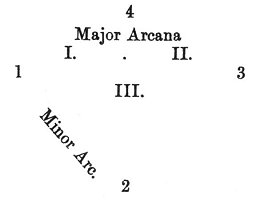
What must we do if we wish to draw out the horoscope of any matter?
1. You should take the minor arcana and separate the suit of cards that refers to the kind of consultation you require.
If it is some business you are about to undertake, you must take the Sceptres or Diamonds. If it is a love affair, take the Cups or Hearts. For a law-suit, or any struggle, take Swords or Spades. In a money matter, the Pentacles or Clubs.
2. Shuffle the cards selected, then ask the Inquirer to cut them.
3. Take the four first cards from the top of the pack, and without looking at them place them in a cross ... , from left to right, as shown by the numbers (1-4).
4. Then take your major arcana (which should always be separated from the minor arcana), shuffle them, and let them be cut for you.
5. You then ask the Inquirer to draw out seven cards from the major arcana by chance, and to give them to you without looking at them.
6. Shuffle these seven cards, and when the Inquirer has cut them, take the three top cards, and without looking at them arrange them in a triangle, in the following order-- (I-II)
7. Take up the cards so that you can see them and read the oracles, noticing that the card placed at number 1 indicates the commencement. The card placed at number 2 indicates the apogee, at number 3 the obstacles, lastly, at number 4 the fall.
The major arcanum placed at I indicates the influences that have weighed in the affair during the Past. The major arcanum in II. indicates the influence exerted over the Present. The arcanum at number III. shows the influence which will affect and determine the Future.
These cards can be very rapidly deciphered when the habit is once acquired. But one important point should be noted, that when the rapid process is used for fortune-telling, the figures do not exclusively represent persons of especial complexion. The King represents a man, without any other distinction, the Queen a woman, the Knight a young man, and the Knave a child.
Spread: Foli's Grand Star

The Number of Cards may Vary.
There are various ways of telling fortunes with cards arranged in the form of a star, and whichever of these may be preferred, it will always be found necessary to use an uneven number of cards in addition to the one representing the inquirer. Some stars are done with thirteen cards, some with fifteen, and so on, but the real Grand Star must have twenty-one cards placed round the representative one.
The Method.
Suppose the inquirer be a fair man, the king of hearts would be the card selected to form the centre of the star. This representative card is placed face upwards on the table, and the remaining thirty-one cards of the pack (the twos, threes, fours, fives, and sixes having been previously removed) must then be shuffled, and cut with the left hand.
In the accompanying diagram the cards are numbered in the order that they are placed in upon the table, taking the representative as No. 1. The mode of withdrawing the cards from the pack is as follows: The first ten cards are thrown aside after the first cut, and the eleventh card is placed below No. 1; then cut out a second time, and place the top card of the pack on the table above No. 1; cut a third time, take the bottom card of the pack in the hand and place it to the left of No. s. The cards must be cut every time a card is to be
withdrawn, and they are taken alternately from the top and bottom of the pack as above directed. Great care should be observed in the placing of the cards in due order, as any deviation will affect the reading at a subsequent stage of the process. The last card, No. 22, is placed across the foot of the representative.
The Reading in Pairs.
When the Grand Star has been thus formed, the cards must read in pairs, taking the outside circle in this order: 14 and 16, 21 and 19, 15 and 17, 20 and 18. Then take the inner circle, moving from left to right thus: 6 and 10, 9 and 12, 8 and 13, 7 and 11; the four centre points are paired thus: 4 and 2, 5 and 3; and the last card, No. 22, is taken separately. The significations are, of course, taken with regard to the relative positions of the cards, and their special reference to the central figure of the inquirer. This is a picturesque and simple way of consulting the cards, and will probably be a favourite with most people.
Diagram of the Grand Star.
The central card, No. 1, represents the inquirer, and each card is numbered in the order in which it is taken from the pack.
Excerpted from "Fortune Telling by Cards" by P.R.S. Foli, 1915.
Reading Tips: The Transfer Process
Draw two cards at random and examine the details that are repeated or are changed from one card to the other: colors, objects, shapes, the direction the figures are looking ... The interpretation can vary depending on the order in which the cards are placed.
~ Jodorowsky
~ Jodorowsky
Thursday, April 6, 2017
The Marseilles Tarot Ethos by Enrique Enriquez
QUESTION:
I've been a subscriber to your list for some time. I've come to really love the rich symbolism of the Rider-Waite deck, but I've also wanted to learn the Marseille's Eteilla symbolism and meanings. While I'm happy to listen to the cards for new meanings each time I read, my head gets a little jumbled automatically imposing the RWS meanings on cards whose images don't support those meanings.
If you had one tip for someone moving from the RWS system to the Marseille's system, what would it be? And while I know each deck has its aesthetic, if you had to describe the difference in ethos between the RWS system and Marseille's system, how would you do it?
Much Thanks,
Paul Sireci
P.S. - I don't read professionally, but I do use both decks daily.
ANSWER:
A description of the Marseille tarot's "ethos" may be tricky as the literature describing it amounts to a succession of the personal, subjective projections of its authors. How not to fall into the same trap?
I wouldn't say there is a Marseille tarot "method." I rather see it as a "tradition."
That tradition can be seen as having two distinctive moments. First there was a time when the image-makers were active, printing tarots. So far, we only have retrieved enough pieces of that puzzle to outline the passing on, generation after generation, of a set of images that have remained somehow consistent, from Jean Noblet (1650) to, perhaps, Nicolas Conver (1760). Sadly, no commentary about the images survived. We know nothing about what these image-makers were thinking when they printed these tarots. We only know the images are preserved with minimal alterations.
The commentary came later. In fact, I would say the second distinctive moment within the Marseille tradition came about in the 1930s, after Paul Marteau "rebranded" these French tarots sharing a similar pattern as "tarots de Marseille". With Marteau, the Marseille tarot became aware of itself. Most people agree that the first appearance of the "Marseille tarot" notion can be found in Papus, who was then referring to these decks either produced in the city of Marseille or exported to the world through the port of Marseille; but for all practical purposes it was Paul Marteau, head of the Grimaud printing house, who in the 1930s "coined" the "Tarot de Marseille" brand and made the deck available for sale. It is said that Marteau was reacting to the increasing popularity of the RWS deck.
In the last ten years we have seen what could perhaps be a third act in this narrative with the edition of decks that hope to "restore" the Marseille tarot images. Most notably we have Chris Haddar, Philippe Camoin and Alejandro Jodorowsky, Jean-Claude and Roxanne Flornoy, Yoav Ben-Dov and Wilfried Houdoin. While the theories and speculations of all these authors may diverge, the point that remains consistent is the preservation of the images. We still see minor additions or alterations, just as we observed among Noblet, Dodal, Chosson, etc. But the images remain the same.
If we observe what happened after the RWS became popular and we contrast it with what has happened to the Marseille tarot, that difference of ethos starts to emerge. For example, the post-RWS "star" is a symbol that stands for something other than a heavenly body. Once we are there, any star will do. Year after year, we see a proliferation of new decks in which the star-as-symbol takes new and different visual incarnations without stopping to clearly describe what The Star card symbolizes.
Within the Marseille tradition, The Star is that precise image of a naked woman pouring water "Ã la belle etoile" (under the night's sky). If we were to modify the image we would be stepping outside the lexicon of the Marseille tarot. I am using here the word "lexicon" with a precise intention, as the main characteristic of the Marseille tarot ethos, the only one on which all the commentators agree, is that we are in the presence of a visual language. It could be argued that all tarots are a visual language, but here we are talking about a language that requires no (symbolic) interpretation, as it manifests through direct comprehension, pretty much like street signs.
For example, we often hear or read how The Star card represents "hope". But hope is an abstract notion. In the Marseille tarot, Lestoile give us the experience of being naked (exposed) kneeling down (surrendered) pouring water (releasing, dropping, giving). The whole image amounts to a feeling of abandonment that we feel in our bodies, not with our heads, and therefore is physical, not intellectual.
If we were to modify the image we see in Arcane 17, switching it for whatever tickles our fancy, we won't experience these feelings. More important, once the image has been modified we won't be able to map its similarities with Temperance, an image in which a (winged) woman stands, holding the same vases we see in The Star. If we were to choose a different image for Temperance, we wouldn't be able to see these vases she is holding in the two twins embracing under The Sun. These twins can be mapped into the dogs we see in The Moon, the two minions in The Devil, the two persons falling from The Tower, or the two acolytes kneeling before The Pope.
If we change one image, the language collapses.
The commentators of the Marseille tradition (Marteau, Unger, Flornoy, Camoin, Jodorowsky, et. al) agree in a few directions:
- Regard the trumps as a whole, not as a series of individual images.
- Pay attention to the characters' gestures and glances.
In the Marseille tarot the gestures of the characters we see in the cards aren't independent occurrences. We see these gestures, details and elements, repeated from card to card in consistent patterns. The Marseille tarot is a tool for experience. In a sense, we could speak here of a kind of visual magic, based on two traditional strategies:
- Visual similarity
- Visual proximity
The Marseille tarot "spells" ideas by presenting us with the recurrence of signs. Elements that look the same are thought to be conceptually related. Elements that occupy the same position in the cards are thought to be conceptually related.
An additional direction which I personally find worth exploring but that has received very little attention is wordplay. Tchalai Unger writes about it with some detail, showing us how LE MAT (another name for The Fool) is a word that suggests "fool" but also "mast", "matte" and death (as in "check mate"). Jodorowsky also points out how some of the trumps names are actual puns, like LE PENDU, which in French can be heard equally as "the hanged one" or "hard bread."
Once we consider wordplay, we open a door to a rich French tradition of both verbal and visual punning that would take us far back, to Rabelais, Rene Marot, medieval heraldry and all of their successive heirs: Gerard de Nerval, Jean-Pierre Brisset, Alfred Jarry, Raymond Roussel, the Surrealists, the Oulipians, and also esoteric writers like Grasset de Orcet, Rene Guenon and the mythical Fulcanelli. All of them were very much aware of the nature of wordplay as an engine for meditation and thought. Understood within that lineage, the Marseille tarot becomes a tool to unlock the mind to the multiversality of signs.
All my Best,
enrique enriquez/hieroglyphic terrorism
I've been a subscriber to your list for some time. I've come to really love the rich symbolism of the Rider-Waite deck, but I've also wanted to learn the Marseille's Eteilla symbolism and meanings. While I'm happy to listen to the cards for new meanings each time I read, my head gets a little jumbled automatically imposing the RWS meanings on cards whose images don't support those meanings.
If you had one tip for someone moving from the RWS system to the Marseille's system, what would it be? And while I know each deck has its aesthetic, if you had to describe the difference in ethos between the RWS system and Marseille's system, how would you do it?
Much Thanks,
Paul Sireci
P.S. - I don't read professionally, but I do use both decks daily.
ANSWER:
A description of the Marseille tarot's "ethos" may be tricky as the literature describing it amounts to a succession of the personal, subjective projections of its authors. How not to fall into the same trap?
I wouldn't say there is a Marseille tarot "method." I rather see it as a "tradition."
That tradition can be seen as having two distinctive moments. First there was a time when the image-makers were active, printing tarots. So far, we only have retrieved enough pieces of that puzzle to outline the passing on, generation after generation, of a set of images that have remained somehow consistent, from Jean Noblet (1650) to, perhaps, Nicolas Conver (1760). Sadly, no commentary about the images survived. We know nothing about what these image-makers were thinking when they printed these tarots. We only know the images are preserved with minimal alterations.
The commentary came later. In fact, I would say the second distinctive moment within the Marseille tradition came about in the 1930s, after Paul Marteau "rebranded" these French tarots sharing a similar pattern as "tarots de Marseille". With Marteau, the Marseille tarot became aware of itself. Most people agree that the first appearance of the "Marseille tarot" notion can be found in Papus, who was then referring to these decks either produced in the city of Marseille or exported to the world through the port of Marseille; but for all practical purposes it was Paul Marteau, head of the Grimaud printing house, who in the 1930s "coined" the "Tarot de Marseille" brand and made the deck available for sale. It is said that Marteau was reacting to the increasing popularity of the RWS deck.
In the last ten years we have seen what could perhaps be a third act in this narrative with the edition of decks that hope to "restore" the Marseille tarot images. Most notably we have Chris Haddar, Philippe Camoin and Alejandro Jodorowsky, Jean-Claude and Roxanne Flornoy, Yoav Ben-Dov and Wilfried Houdoin. While the theories and speculations of all these authors may diverge, the point that remains consistent is the preservation of the images. We still see minor additions or alterations, just as we observed among Noblet, Dodal, Chosson, etc. But the images remain the same.
If we observe what happened after the RWS became popular and we contrast it with what has happened to the Marseille tarot, that difference of ethos starts to emerge. For example, the post-RWS "star" is a symbol that stands for something other than a heavenly body. Once we are there, any star will do. Year after year, we see a proliferation of new decks in which the star-as-symbol takes new and different visual incarnations without stopping to clearly describe what The Star card symbolizes.
Within the Marseille tradition, The Star is that precise image of a naked woman pouring water "Ã la belle etoile" (under the night's sky). If we were to modify the image we would be stepping outside the lexicon of the Marseille tarot. I am using here the word "lexicon" with a precise intention, as the main characteristic of the Marseille tarot ethos, the only one on which all the commentators agree, is that we are in the presence of a visual language. It could be argued that all tarots are a visual language, but here we are talking about a language that requires no (symbolic) interpretation, as it manifests through direct comprehension, pretty much like street signs.
For example, we often hear or read how The Star card represents "hope". But hope is an abstract notion. In the Marseille tarot, Lestoile give us the experience of being naked (exposed) kneeling down (surrendered) pouring water (releasing, dropping, giving). The whole image amounts to a feeling of abandonment that we feel in our bodies, not with our heads, and therefore is physical, not intellectual.
If we were to modify the image we see in Arcane 17, switching it for whatever tickles our fancy, we won't experience these feelings. More important, once the image has been modified we won't be able to map its similarities with Temperance, an image in which a (winged) woman stands, holding the same vases we see in The Star. If we were to choose a different image for Temperance, we wouldn't be able to see these vases she is holding in the two twins embracing under The Sun. These twins can be mapped into the dogs we see in The Moon, the two minions in The Devil, the two persons falling from The Tower, or the two acolytes kneeling before The Pope.
If we change one image, the language collapses.
The commentators of the Marseille tradition (Marteau, Unger, Flornoy, Camoin, Jodorowsky, et. al) agree in a few directions:
- Regard the trumps as a whole, not as a series of individual images.
- Pay attention to the characters' gestures and glances.
In the Marseille tarot the gestures of the characters we see in the cards aren't independent occurrences. We see these gestures, details and elements, repeated from card to card in consistent patterns. The Marseille tarot is a tool for experience. In a sense, we could speak here of a kind of visual magic, based on two traditional strategies:
- Visual similarity
- Visual proximity
The Marseille tarot "spells" ideas by presenting us with the recurrence of signs. Elements that look the same are thought to be conceptually related. Elements that occupy the same position in the cards are thought to be conceptually related.
An additional direction which I personally find worth exploring but that has received very little attention is wordplay. Tchalai Unger writes about it with some detail, showing us how LE MAT (another name for The Fool) is a word that suggests "fool" but also "mast", "matte" and death (as in "check mate"). Jodorowsky also points out how some of the trumps names are actual puns, like LE PENDU, which in French can be heard equally as "the hanged one" or "hard bread."
Once we consider wordplay, we open a door to a rich French tradition of both verbal and visual punning that would take us far back, to Rabelais, Rene Marot, medieval heraldry and all of their successive heirs: Gerard de Nerval, Jean-Pierre Brisset, Alfred Jarry, Raymond Roussel, the Surrealists, the Oulipians, and also esoteric writers like Grasset de Orcet, Rene Guenon and the mythical Fulcanelli. All of them were very much aware of the nature of wordplay as an engine for meditation and thought. Understood within that lineage, the Marseille tarot becomes a tool to unlock the mind to the multiversality of signs.
All my Best,
enrique enriquez/hieroglyphic terrorism
Subscribe to:
Posts (Atom)